Self-Employed Carer vs Care Agency: Which Is Right for Your Family?

Published by
Care Opt Editorial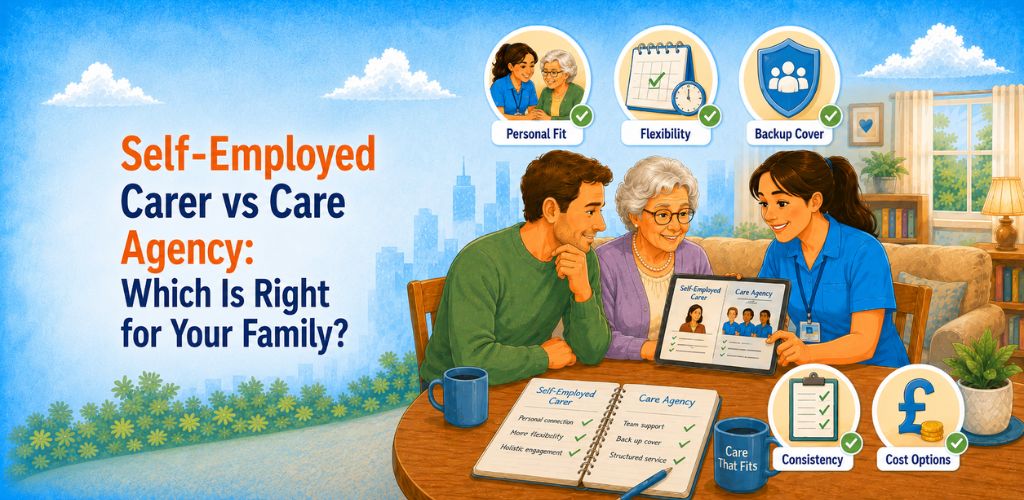
Compare a self-employed carer and a care agency in the UK, including cost, flexibility, checks, legal duties and which option suits your family best.
Self-Employed Carer vs Care Agency: Which Is Right for Your Family?
Choosing the right care at home is one of the most important decisions a family can make.
For many people in the UK, the choice often comes down to two main options: working with a self-employed carer or arranging support through a care agency. Both models can work well, but they are not the same. They differ in flexibility, cost, continuity, responsibilities, and how the support is managed.
Some families want more control and a more personal arrangement. Others want the reassurance of a fully managed service. Neither option is automatically right for everyone.
This guide explains the difference between a self-employed carer and a care agency, the pros and cons of each, what legal and practical issues to think about, and how to decide which model is best for your situation.
What Is a Self-Employed Carer?
A self-employed carer is a care worker or support worker who provides services independently rather than as an employee of a care agency.
They may offer support such as:
- Personal care
- Companionship
- Help with meals
- Shopping and errands
- Support with appointments
- Household tasks
- Dementia support
- Autism support
- Learning disability support
- Recovery support at home
In a true self-employed arrangement, the worker is running their own business and providing services under a contract for services. They are generally responsible for their own tax, records, and insurance.
What Is a Care Agency?
A care agency is a business that arranges and manages care workers on behalf of clients.
In most cases, the agency recruits the staff, carries out checks, manages rotas, deals with payroll, and provides replacement cover when a worker is unavailable. Where an agency is providing personal care as a homecare service in England, it will usually need to be registered with the Care Quality Commission.
For families, this can feel more structured because the agency takes responsibility for managing the service.
Why Families Compare These Two Options
When families start looking for private care or care at home, they are often trying to solve several problems at once.
They want support that is:
- Safe
- Reliable
- Affordable
- Flexible
- Suitable for the person’s needs
- Easy to arrange and maintain
The reason this comparison matters is simple: a self-employed arrangement can offer more choice and continuity, while an agency can offer more management and cover. The right answer depends on what matters most to your family.
Self-Employed Carer: Main Advantages
More choice and control
One of the biggest reasons families choose a self-employed care worker is control.
You can often choose the person yourself, speak with them directly, and decide whether they are the right fit. This can be especially important if the person receiving care values consistency, familiarity, and a more personal relationship.
Better continuity
Many families prefer seeing the same person regularly.
With an agency, visits may sometimes be shared across different carers depending on rota changes, staffing levels, or sickness cover. A self-employed arrangement can make it easier to build continuity if the same worker is supporting the person each week.
More flexibility
A private carer working independently may be able to offer a more flexible arrangement around visit times, routines, and preferences.
This can work well for families who need support built around real life rather than around fixed care rounds.
More personal communication
Families often value being able to speak directly with the person providing support, rather than always going through an office.
This can make planning and day-to-day communication feel simpler.
Self-Employed Carer: Main Disadvantages
More responsibility for the family
This is the part people sometimes underestimate.
If you arrange support directly, you may need to take more responsibility for checking documents, agreeing terms, handling communication, and thinking about contingency planning if the worker is unavailable.
If you directly employ someone, rather than genuinely contract with a self-employed person, you may also take on employer responsibilities. That can include contracts, payroll, tax, holiday pay, pensions and other legal duties.
Less built-in cover
If a self-employed carer is sick, on holiday, or suddenly unavailable, there may not be an automatic replacement.
That does not mean the arrangement is wrong. It just means families should think ahead about what happens if cover is needed.
Greater need for due diligence
Families should never assume that an independent worker is properly checked just because they seem experienced.
You should still ask about:
- DBS checks
- Right to work
- References
- Relevant training
- Insurance
- Experience with similar needs
Care Agency: Main Advantages
Managed service
This is the main attraction of an agency.
The agency usually takes responsibility for recruitment, checks, rotas, payroll, supervision, and general service management. For families who do not want to organise these things themselves, that can be a significant advantage.
Easier cover arrangements
If one worker is off sick or on leave, an agency is more likely to arrange a replacement.
This can be particularly important where the person receiving support has high needs or cannot safely miss visits.
More formal structure
Some families feel more comfortable with an established organisation behind the service.
That can include written care plans, office-based support, complaints processes, and a more formal framework for managing the package.
Care Agency: Main Disadvantages
Less personal choice
With an agency, the family may not always have full control over which worker attends each visit.
Even when an agency tries to keep continuity, staffing pressures can affect the rota.
Less flexibility
Some agencies can be very responsive, but others work within tight visit schedules and standard processes.
Families who need a more tailored, relationship-based arrangement sometimes find this restrictive.
Communication can feel less direct
Messages often need to go through the office rather than straight to the worker. That can slow down changes or make the arrangement feel less personal.
Which Option Is Safer?
Neither model is automatically safer just because of the label.
A poor agency can still provide inconsistent support. A strong self-employed carer can still provide excellent, professional care. Safety depends on how the arrangement is set up and managed.
What matters is whether proper checks and standards are in place.
For any private care arrangement, families should ask:
- Has identity been verified?
- Is there a current DBS check?
- Is there proof of right to work in the UK?
- Are references available?
- Does the worker have relevant experience?
- Is insurance in place where appropriate?
- Is there a clear agreement about the service?
- Is there a plan for emergencies or missed visits?
A platform that helps families find carers and checks documents can reduce risk, but it should not replace judgement. Families still need to assess fit, communication, and suitability.
Legal and Compliance Points Families Should Understand
This is where the difference between the two models becomes important.
If you use a care agency
Where a homecare agency provides personal care in England, it will usually need to meet CQC registration requirements. Families are not expected to manage the agency’s staffing, payroll or employer obligations.
If you arrange support directly
If a person or family directly arranges care with an individual worker, the legal position can be different.
Some directly arranged individual care worker arrangements may fall outside CQC registration where the worker is acting as an individual and works under the direction and control of the person receiving care or their representative.
However, that does not mean there are no responsibilities. Families still need to think carefully about employment status, paperwork, checks and risk. In some cases, the person paying the carer may legally be the employer. Employment status is based on the reality of the arrangement, not just the label used.
This point is important because some people call someone “self-employed” when the arrangement actually looks more like employment.
Step-by-Step: How to Decide Which Option Is Right for Your Family
1. Start with the person’s needs
Think about what support is actually required.
Is it mainly companionship and household help? Is it personal care? Is it specialist support for dementia, autism, learning disabilities, or recovery after illness?
The more complex or time-critical the support, the more important contingency planning becomes.
2. Decide how much control you want
Some families want a highly personal arrangement where they choose the worker themselves and build a direct relationship.
Others would rather have a managed service where the organisation handles the administration and cover.
Neither view is wrong. It is about what suits your household.
3. Think about continuity
If the person receiving care relies heavily on routine, familiarity and trust, continuity may be one of the most important factors.
In those cases, a private carer or self-employed support worker may feel more suitable, provided the checks are in place and the arrangement is properly structured.
4. Think about backup cover
Ask yourself what would happen if the usual worker could not attend.
If missing a visit would create major risk, an agency’s ability to arrange cover may be a significant advantage.
5. Check the practical responsibilities
If you are considering direct arrangements, be honest about whether you are willing to handle more of the checking and decision-making.
If the arrangement may make you the employer, you also need to understand the extra obligations that can follow.
6. Check documents and references carefully
Whichever route you choose, do not skip the basics.
Ask for:
- DBS details
- Right to work documents
- References
- Relevant training
- Insurance information
- Clear terms of service
Common Mistakes to Avoid
Assuming “self-employed” always means simpler
It can be more flexible, but it is not always simpler. If employment status is wrong, problems can follow later.
Choosing based on price alone
Cost matters, but cheap support that is unreliable or unsuitable is poor value.
Focusing only on paperwork
Documents matter, but they are not enough on their own. Communication, reliability and fit matter too.
Ignoring contingency planning
This is one of the biggest practical mistakes. Every arrangement should have a plan for sickness, holidays or emergencies.
Not asking who is actually responsible
Families should understand who is responsible for checks, cover, supervision, and resolving issues.
When a Self-Employed Carer May Be the Better Option
A self-employed carer may suit your family if:
- You want more choice over who provides support
- Continuity matters a great deal
- You value direct communication
- The support can be arranged safely with proper checks
- You are comfortable taking a more active role in the arrangement
This route often appeals to families who want a more personal, relationship-led model of care at home.
When a Care Agency May Be the Better Option
A care agency may suit your family if:
- You want a fully managed service
- Backup cover is essential
- The support package is more complex
- You do not want to manage direct arrangements
- You prefer a more formal organisational structure
For some families, especially where care is intensive or highly time-sensitive, that extra structure is worth it.
FAQ
Is a self-employed carer cheaper than a care agency?
Sometimes, but not always. The better question is what value, flexibility and responsibilities come with the arrangement.
Is a self-employed carer legal in the UK?
Yes, genuine self-employed arrangements can exist. But employment status must be correct in practice, not just in name.
Does a self-employed carer need CQC registration?
Not usually if they are an individual worker in an exempt direct arrangement. That is different from a homecare agency providing personal care, which will usually need registration in England.
Is an agency safer than a private carer?
Not automatically. Safety depends on checks, structure, management, and the quality of the person or service.
What should I ask before choosing either option?
Ask about checks, references, experience, cover arrangements, communication, insurance and who is responsible for managing the service.
Final Thoughts
The choice between a self-employed carer and a care agency is really a choice between two different models of support.
One offers more personal control and often more continuity. The other offers more management and easier cover. The best option depends on the person’s needs, your family’s preferences, and how much responsibility you want to take on.
Whichever route you choose, the basics remain the same: define the support needed clearly, ask the right questions, check documents and references, and make sure the arrangement is safe as well as convenient.
If you are looking for trusted private care and want a more flexible way to find the right support, see how it works or contact us. If you are a self-employed care worker looking to connect with families, you can sign up or visit our careers page.

About the Platform
Care Opt Team
The Care Opt Editorial Team provides expert insights and resources dedicated to empowering individuals through knowledge and compassionate community support.